Why Constraints Aren’t the Enemy
It is true that nobody likes limits.
Deadlines, budgets, company policies, or approval chains can feel like roadblocks between us and our ideas.
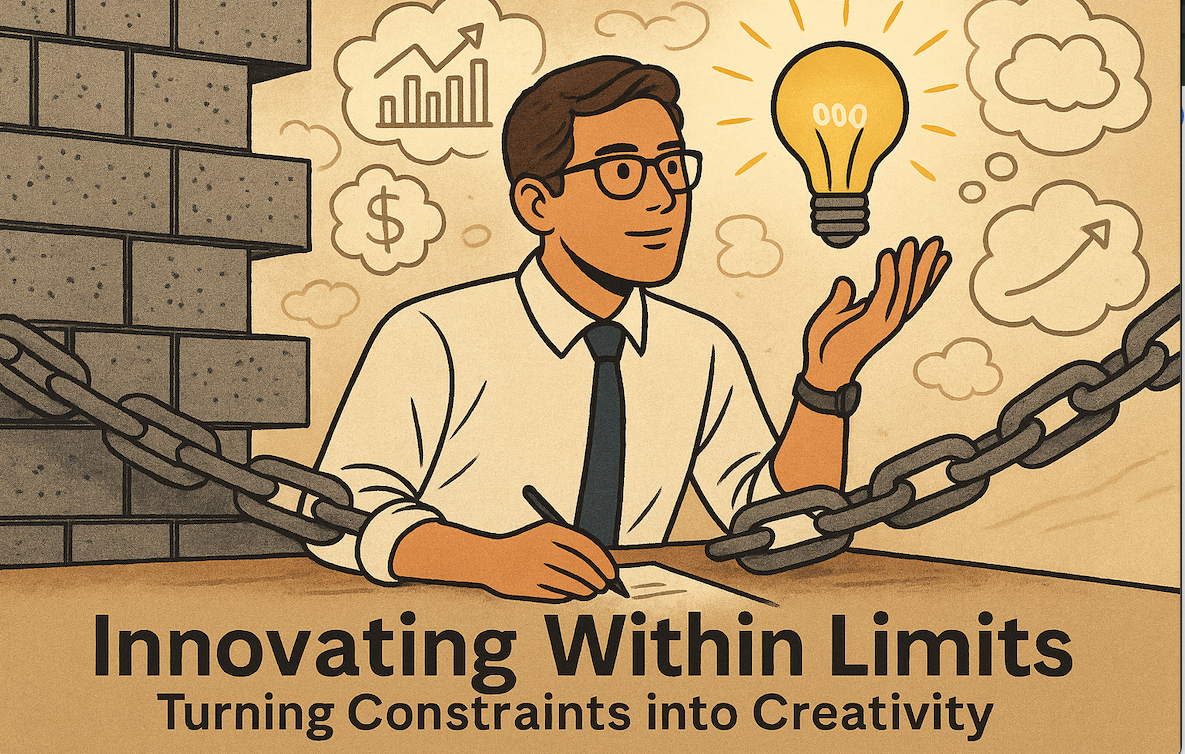
But here’s the truth: some of the most creative breakthroughs in history happened because of limits, not in spite of them.
When resources are endless, creativity gets lazy. When resources are tight, creativity gets sharper.
That’s the Emplopreneur advantage — learning to turn every constraint into a catalyst for improvement.
The Myth of “When I Have More Freedom…”
Have you ever told yourself, “Once I have more time (or money, or support), then I’ll start”?
That’s a myth. Freedom doesn’t create innovation — focus does.
Constraints give you focus. They force you to define what matters, make faster decisions, and find smarter paths.
Think about the early days of startups. With limited budgets, small teams, and high pressure, they innovate faster than big corporations. Why? Because every decision counts.
As an Emplopreneur, you already have access to this power. Your job’s boundaries aren’t barriers — they’re design parameters. They help you refine your creativity instead of scattering it.
The Science of Constraint-Driven Creativity
Psychologists call it creative limitation. It’s the principle that boundaries can boost innovation by forcing our brains to connect unrelated ideas.
For example:
- The Post-it Note was invented when 3M’s researchers failed to make a strong adhesive — and decided to use the “weak” one in a new way.
- LEGO redesigned its entire business model after facing bankruptcy, focusing on creativity within fewer product lines.
- In Japan, the philosophy of wabi-sabi celebrates beauty in imperfection and limitation.
In each case, what seemed like a restriction became the source of innovation.
That’s what the Emplopreneur mindset teaches you: you don’t need more — you need to use what you already have, better.
Applying the DMAIC Framework to Innovation
As a Six Sigma thinker, you already know that structured thinking unlocks results.
Here’s how to apply the DMAIC framework to innovate within your limits:
- Define your challenge clearly.
“Our team is overwhelmed by emails.” - Measure what’s really happening.
Track how much time is lost daily to this problem. - Analyze the root causes.
Are there unclear priorities? Poor communication channels? - Improve within the boundaries.
Create templates, introduce shared notes, automate updates. - Control the change.
Track the new workflow and sustain the improvement.
You don’t need a bigger budget or new tools to innovate — just a process and a willingness to test.
That’s how small changes compound into transformation.
Story: Innovation from the Inside
A client of mine, Daniel, was a product engineer frustrated by how long design approvals took. The process was bureaucratic, slow, and riddled with unnecessary steps.
Instead of complaining, he used his Builder Hours to map the approval flow and realized most delays came from unclear ownership. He suggested a simple fix: one shared dashboard that tracked every design’s status and next action.
The result? The team cut turnaround time by 40% — without hiring anyone or buying new software.
Daniel didn’t need permission to innovate. He just needed a process.
How to Practice “Constraint Thinking” at Work
You can develop your innovation muscle by treating constraints as creative prompts. Here’s how:
- Ask Better Questions.
Instead of “Why can’t we do this?”, ask “How can we do this within our limits?” - Reduce Before You Add.
Simplify before scaling. Innovation often comes from subtraction, not addition. - Prototype Fast, Perfect Later.
Build small, test quickly, refine continuously. Speed over polish. - Document the Lesson.
Capture what worked so others can replicate it. That’s how small wins become culture shifts.
The Emplopreneur Advantage
When you stop resenting constraints and start using them, you become unstoppable.
You start to see opportunities where others see obstacles.
You turn frustration into fuel.
Every Emplopreneur learns this truth: freedom isn’t the absence of limits — it’s the ability to create within them.
Action Time
This week, try this simple challenge:
- Identify one constraint you’ve been complaining about — time, budget, approval, or tools.
- Reframe it as a design prompt: “How can I make this easier or faster because of the limit?”
- Test one improvement and measure its impact.
Innovation doesn’t require permission. It requires perspective.
Remember: limits don’t shrink creativity — they sharpen it.
Your creativity, your courage — optimized.