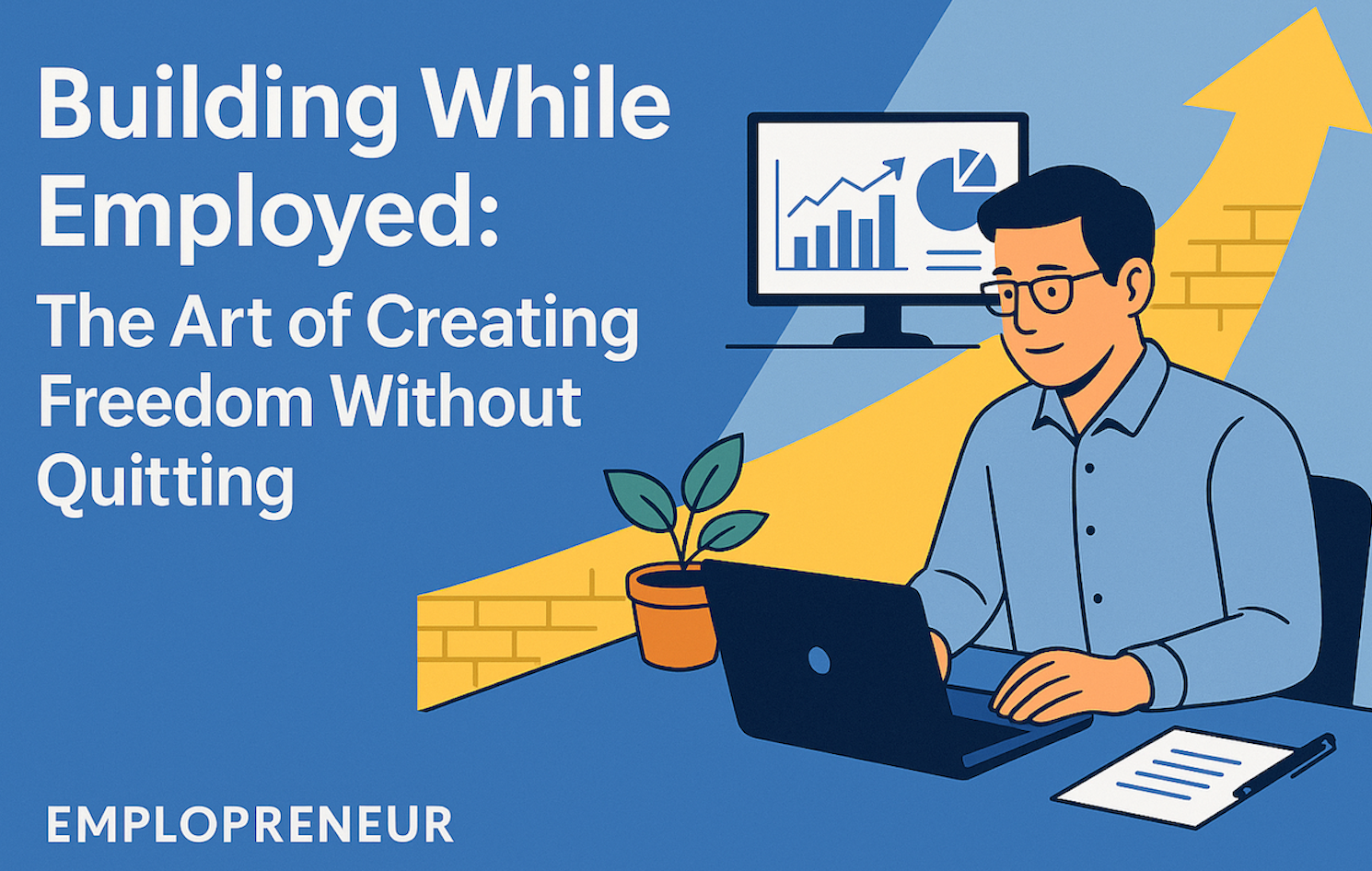
You Don’t Have to Quit to Grow
The world loves dramatic stories — the “I quit my job and built an empire” kind.
But what we don’t hear enough are the smart, strategic stories — the ones where people build while employed.
That’s the Emplopreneur’s story.
They don’t throw away stability to chase freedom. They design freedom while keeping stability intact.
They treat their career as a launchpad, not a limitation.
This is the art of the middle path — where you create new opportunities without creating chaos.
The Myth of “All or Nothing”
Most professionals believe they face two choices:
- Option A: Stay stuck in their job forever.
- Option B: Quit and hope their next thing works out.
That’s a false choice.
There’s a third way — the Emplopreneur way — where you build your next chapter in parallel with your current one.
You start before you’re ready. You test small ideas. You validate your skills in the market. And when the bridge is strong enough, you cross it confidently — not desperately.
That’s how professionals evolve into entrepreneurs without losing their peace of mind.
Why Building While Employed Works
Here’s why this approach is not just practical, but powerful:
- Financial Security = Creative Freedom.
Your paycheck funds your experiments, reducing pressure and burnout. - Built-in Training Ground.
Every day at work teaches you processes, systems, and business models you can later apply to your own ventures. - Low-Risk Learning.
You can test, fail, and refine ideas without betting your entire livelihood. - Momentum Without Mayhem.
Progress becomes consistent, not chaotic. You’re building a bridge, not leaping into a void.
This is the balance that most people crave — and Emplopreneurs master.
How to Balance Both Worlds Without Burning Out
Balancing a full-time job and a personal project isn’t about working more hours — it’s about working intentionally.
Here’s how:
- Set Clear Boundaries.
Define when you work on your job and when you build your future. Keep both sacred. - Use Builder Hours.
Schedule focused time blocks — 60 minutes, three times a week — where you work on your projects with zero distractions. - Communicate Wisely.
You don’t need to broadcast your side project, but don’t hide it in fear either. Be transparent if it overlaps professionally, and respect your employer’s policies. - Measure Energy, Not Just Time.
Track when you feel most creative or focused. That’s when you should schedule your Builder Hours. - Celebrate Small Wins.
Momentum is built on progress, not perfection. Every small step compounds.
Story: How One Engineer Built His Freedom Slowly
Take Arun, a systems engineer who loved his job but wanted more freedom. He started consulting part-time on weekends, helping small businesses automate workflows.
He didn’t quit. He refined.
After 18 months, his consulting income matched his salary — and he still liked his day job. So, instead of leaving, he negotiated a 4-day workweek to focus on both.
Three years later, Arun transitioned to full-time consulting — not from frustration, but from foundation.
That’s the Emplopreneur way: plan before you pivot.
How to Choose What to Build
If you’re unsure what to build, start with what you already know and enjoy. Ask yourself:
- What do people already ask me for help with?
- What problem can I solve faster or better than most?
- What skill or interest keeps pulling my attention?
You don’t need to reinvent yourself. You just need to monetize what you already do well — a little differently.
Examples:
- A project manager creates a course on workflow design.
- A teacher starts tutoring online.
- A marketing manager begins offering strategy sessions for nonprofits.
Each one builds within their expertise — not outside it.
Building Without Breaking: Protecting Your Job and Reputation
Being an Emplopreneur means being ethical and smart about how you build.
✅ Use personal time for personal projects.
Never blur the line between employer resources and your own work.
✅ Avoid direct competition.
Don’t create something that competes with your company’s core business.
✅ Stay professional.
Your employer’s respect can become your first source of clients or referrals later.
Building freedom doesn’t mean burning bridges. It means strengthening them.
How to Know When It’s Time to Transition
Eventually, your side project may grow enough to deserve your full focus. Here are signs you’re ready:
- You have steady income from your project for 6–12 months.
- You’ve built repeatable systems (marketing, delivery, finances).
- You feel more pulled toward building than you do toward maintaining.
- You’ve planned your financial runway and health coverage.
That’s when the shift from Emplopreneur to full Entrepreneur becomes a strategic move — not an emotional escape.
Action Time
This week:
- Identify one skill or idea you could explore outside your job.
- Schedule your first Builder Hour to start testing or learning about it.
- Track your energy and progress weekly — not to judge, but to adjust.
Remember:
You don’t have to quit your job to start your future.
You just have to begin building — intentionally, consistently, and wisely.
Freedom isn’t found in leaving something.
It’s found in creating something while staying balanced.
Your work, your dreams, your life — optimized.